
Most owners know a useful post when they see one. It reads like someone who knows their trade answering a question properly. The difficulty is finding the time to write one, week after week.
This article covers the first part: what a useful post actually sounds like, with examples you can adapt. Then we’ll be straightforward about the second part.
Start with a question a customer has actually asked
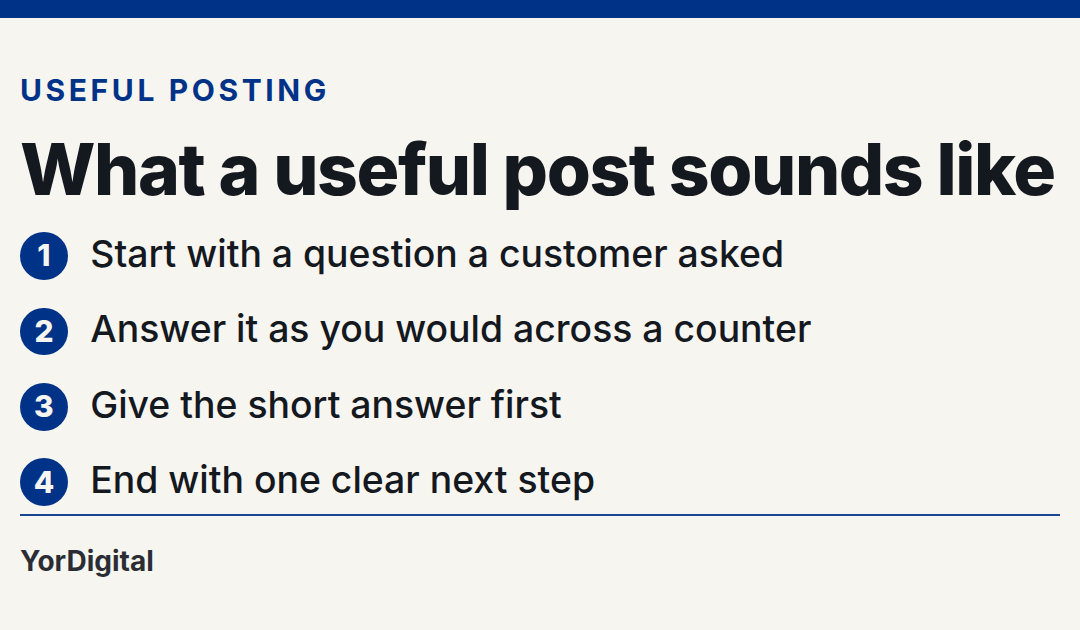
The simplest recipe for a useful post is this: take a question a customer has really asked you, and answer it plainly, the way you would across a counter.
You already hear these questions all the time:
- The first things people ask in an enquiry call or email.
- What you find yourself explaining again and again.
- The question that comes up just before someone decides to go ahead, or not.
- The thing people often get wrong before they come to you.
Write the question down in the customer’s own words. Then answer it in the order you would say it out loud: the short answer first, the reason second, what to do next third. Then stop. A post that answers one question well is worth more than one that tries to cover everything.
Three examples you can borrow
These show the shape of a useful post. They are illustrations, not real client stories, so swap in your own facts and your own way of working.
A consultancy
The question: “Do we need a full review, or can we fix one problem first?”
A useful answer: Say plainly that it depends on whether the problem is a symptom of something wider. Give two or three signs that point to a single, contained problem, and two or three that suggest something bigger. Finish with what you would look at first to tell the difference. None of that needs a statistic. It needs your judgement, written down in ordinary words.
A trades business
The question: “Should I repair this or replace it?”
A useful answer: Give the rule of thumb you actually use. Explain how you weigh the age of the equipment against the likely cost of the repair and the chance of it failing again, and what you check before giving a view. Then tell the customer one thing they can do now, such as sending you a photo of the label with the model details, so you can give a straight answer sooner.
A clinic
The question: “What happens at my first appointment?”
A useful answer: Walk through it in order: who they will meet, what you will ask, what to bring, what will and won’t happen that day, and what comes afterwards. Most people asking this are really asking “what will it be like?”, and a calm, specific walkthrough answers it. Stick to how your clinic works, and leave out claims about outcomes.
The real obstacle is time, not ideas
If you read those examples and thought “I could write that”, you’re probably right. Owners rarely run out of questions to answer. The week fills up with real work, and the post that would take half an hour gets pushed to next week, then the week after.
That is the problem we built YorDigital Presence to solve. Each morning, one finished post and graphic arrives by email. Say today’s is a plain answer to “Should I repair this or replace it?”. You read it over coffee and reply “yes”, and it’s ready to post. If it isn’t quite right, you reply “no, because it’s too formal for how we talk to customers”, and you get a better version. The service learns from the reasons you give.
We run YorDigital Presence on our own pages first, and this article came from it. The same approach already runs daily social content for an estate agency. We have no results to quote yet, and we would rather say so than make something up.
A quick check before you publish
Whether you write it yourself or it arrives in your inbox, run any post past these four questions:
- Can you point to a customer, or a type of customer, who asked this?
- Does the first sentence give the answer, or at least the direction of it?
- Would it read the same if you said it aloud to someone at the counter?
- Does it end with one next step, and only one?
If the answer to all four is yes, post it. It doesn’t need more polish.
YorDigital Presence starts with a free plan: what to post, where and how often. If a finished post each morning, with only a yes or a no to decide, would help your business, see how it works at yordigital.com/products/presence.